
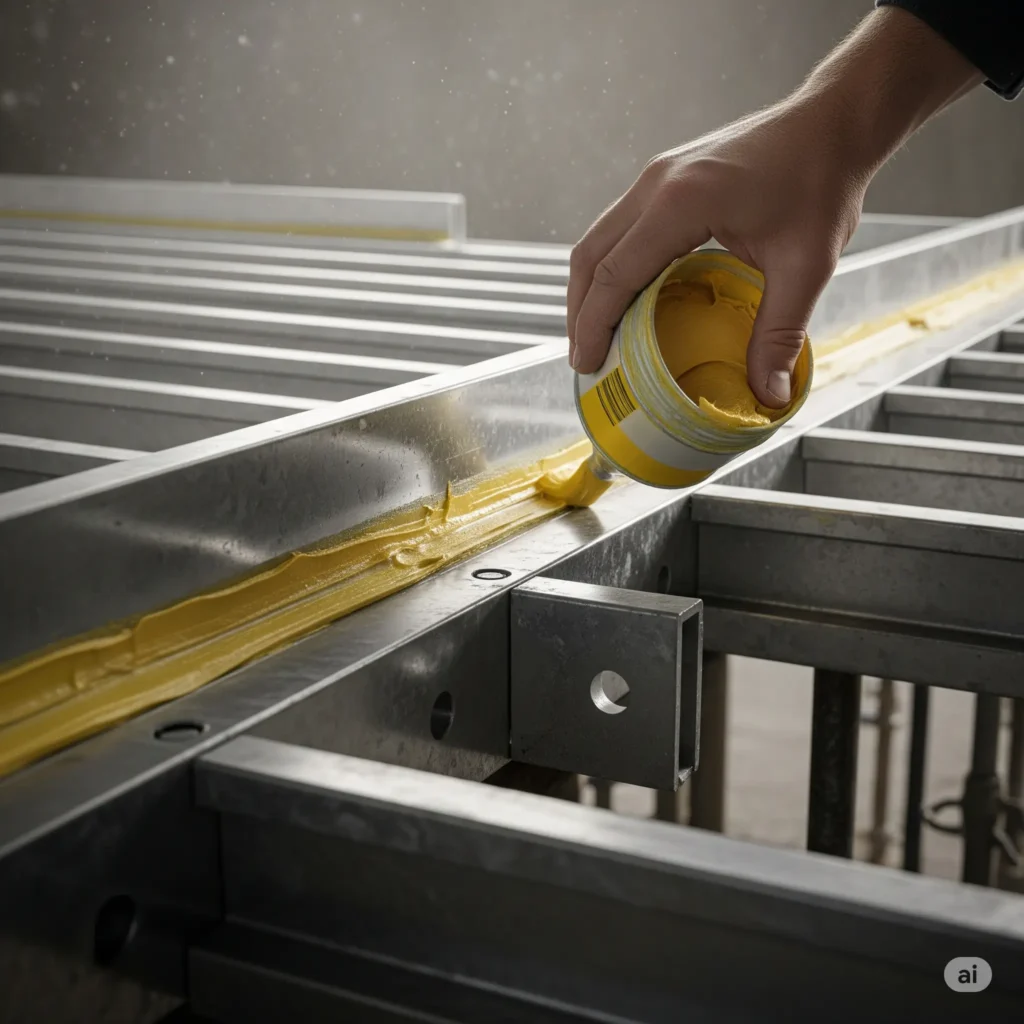
On a construction site, batata grease (yellow grease) goes on slow, wet, lightly loaded steel: shuttering hardware, tie rods, prop and jack threads, cuplock base jacks, trolley and barrow wheels, and steel stored through the monsoon. It does not go on hoists, wire ropes, crane slew rings or any point where the equipment maker names a grade.
Batata grease is cheap, soft and water-resistant, so most sites keep a pail of it in the store. The trouble starts when that one pail gets used everywhere. This guide walks through each place it earns its keep, how to apply it there, and the points where you must use something else. If you are new to the product, start with what is batata grease.
Quick list: where batata grease goes on site
| Point | Why grease it | How |
|---|---|---|
| Tie rods, wing nuts, anchor nuts | Nuts run free after concrete splash; less rust | Thin film on threads before fixing |
| Props and adjustable jacks | Screw turns by hand after weeks outdoors | Brush the thread, wipe the excess |
| Cuplock base jacks and U-heads | Free adjustment, less seizing | Thin film on the screw thread only |
| Trolley and barrow wheels | Axles and bushes turn smoothly | Small dab at the axle or bush |
| Steel stored in the monsoon | Slows rust between jobs | Thin coat before stacking, clean before reuse |
| Workshop and yard | Hinges, vice screws, clamps, slides | Light smear, reapply when dry |
Formwork hardware
Shuttering hardware is the biggest use of batata grease on most sites. Tie rods, wing nuts, anchor nuts, clamps and wedge slots all get covered in slurry, then sit in rain and sun between pours. A thin film on the threads keeps the nut turning when the crew strips the form, and it slows the rust that makes threads bind.
Apply it to the threads and moving parts only. Keep it off the panel face that touches the concrete, because grease on the face can stain the surface and weaken the bond for plaster or paint. The face needs a release agent instead. For the full routine on conventional shuttering, see batata grease for shuttering.
Clean the slurry off a thread with a wire brush before you grease it. Grease spread over set cement just traps the grit, and the nut still jams.
Props and adjustable jacks
Steel props and screw jacks stand under slabs for weeks. By the time you strip, the outer tube and the thread are caked with concrete and starting to rust. A greased thread lets the crew lower the prop by hand instead of hammering the collar.
Brush grease along the threaded section when the prop comes back to the yard, then again before it goes out. Wipe off the excess so it does not pick up sand.
Couplers and cuplock
On cuplock and tube scaffolding, the threads are the useful place for batata grease. Base jacks and U-head jacks are screws, and a light film keeps them adjustable through the job. Coupler bolts can take a little grease on the thread so the nut runs on and off cleanly.
Two limits matter here. Keep grease off the inside of a coupler and off the tube where the coupler grips, because a greasy grip can slip. Follow your scaffold supplier’s instructions for tightening couplers, since grease on a bolt changes how it tightens. The cups and ledger blades of cuplock lock by fit and wedging, so leave them clean and dry.
Greasing a whole scaffold component “for rust”. Grease on grip and locking surfaces is a safety problem, not a maintenance step. Grease the threads, nothing else.
Trolley and barrow wheels
Wheelbarrows, material trolleys, mortar pans on wheels and small hand carts all run on simple axles or plain bushes. They move slowly, carry light loads and get washed with water every day. That is the kind of point batata grease suits.
Push a small dab into the axle or bush, turn the wheel a few times and wipe off what squeezes out. Reapply weekly in the monsoon, since water and slurry wash it out. If the wheel has a sealed ball bearing, it was packed at the factory, so leave it alone or follow the maker’s instructions.
Steel stored through the monsoon
Props, tie rods, base jacks, clamps and steel plates often sit in a yard from June to September. Bare steel rusts fast in Mumbai rain. A thin coat of batata grease before stacking slows that rust and keeps threads usable for the next job.
- Clean first. Remove slurry and loose rust before you coat anything.
- Coat thin. A thin film protects. A thick layer only collects dirt and wastes grease.
- Stack off the ground. Use wooden battens and cover the stack if you can.
- Check monthly. Rain washes grease off exposed faces, so touch up the bare spots.
- Clean before reuse. Wipe plate faces before they go back into a form so grease does not reach the concrete face.
Workshop and yard uses
The site workshop and store use batata grease for small, slow jobs: gate hinges, sliding gate rollers and channels, vice and clamp screws, rolling shutter guides and the hand tools that live outdoors. These points see water and dust but little heat or load, so a cheap water-resistant grease does the job.
For machines, check the service manual first. Some slow, open pins on older site machines take a general calcium grease, but many modern machines name a grade for each point. Where the manual names a grade, use that grade.
Do not use batata grease on these
Batata grease is a general-purpose calcium grease that softens with heat. It is not made for heavy, shock-loaded or safety-critical points. Keep it off the following, and use what the equipment maker specifies:
- Hoists. Passenger and material hoist gearboxes, racks and pinions.
- Wire ropes and slings. Ropes need a rope lubricant that gets into the core, not a heavy surface grease.
- Crane slew rings. Tower and mobile crane slew rings and their auto-lube systems.
- EP-critical points. Heavily loaded gears, pins and bearings where the maker asks for an EP grease.
- Hot or fast bearings. Motors, pumps running hot and high-speed spindles.
- Concrete faces. Any surface to be plastered, painted, waterproofed or bonded.
- Grip and locking faces. Inside scaffold couplers and on cuplock cups and blades.
If you are switching a part from a lithium grease to batata grease, or the other way round, clean out the old grease first. The two can be incompatible, as explained in yellow grease vs lithium grease.
When in doubt, read the plate or the manual. If the equipment maker names a grease, that instruction wins over price, habit or what the last crew used.
How to apply and store it on site
Decant from the pail into small lidded tins, one per gang, using a clean scoop. Apply with a stiff brush or a gloved hand, and wipe off the excess. An open pail on the deck fills with dust and slurry in a day. Keep pails closed and in the shade, since calcium grease softens in the sun.
Buying batata grease for site use
KE quotes yellow grease at Rs 65 per kg, plus delivery and GST, for any quantity. Consistency is made to your requirement: firmer for hardware left in the sun, softer for brushing onto threads. Most buyers ask for a sample first and test it on their own hardware. Prices on online marketplaces are listing prices, not market rates, so compare a written quote with delivery included. The full breakdown is in our batata grease price guide.
Krish Enterprises, K.J. Complex, Diva, Thane 400612. Call or WhatsApp +91 96194 84337.
Frequently asked questions
Where is batata grease used on a construction site?
On slow, wet, lightly loaded steel: tie rods, wing nuts, prop and jack threads, cuplock base jacks, trolley and barrow wheels, and steel stored through the monsoon.
Can I use batata grease on a hoist or wire rope?
No. Hoists, wire ropes, crane slew rings and other EP-critical points need the grease or lubricant the equipment maker specifies.
Can batata grease be applied to the shuttering face?
No. Grease on the face can stain the concrete and weaken the bond for plaster or paint. Use a release agent on the face and grease only on threads and moving hardware.
Does batata grease stop rust on props in the monsoon?
A thin film slows rust on stored props, tie rods and jacks. Rain washes it off exposed faces, so check the stack monthly and touch up bare spots.
Can I grease scaffold couplers with batata grease?
Only the bolt threads, lightly. Keep grease off the inside of the coupler and the tube where it grips, and follow your scaffold supplier’s tightening instructions.
What is the price of batata grease?
KE quotes yellow grease at Rs 65 per kg, plus delivery and GST, for any quantity. Ask for a sample on WhatsApp before you order.