
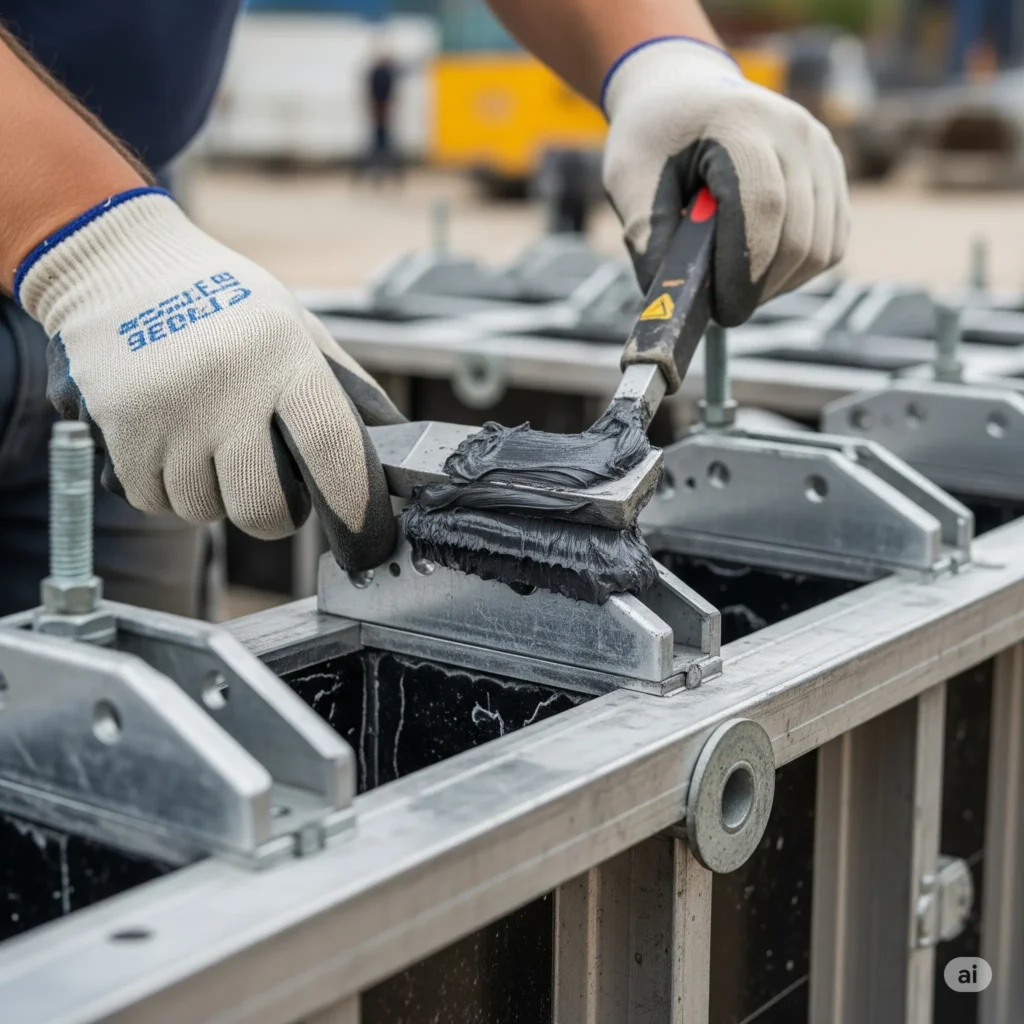
To trial a Mivan grease sample, grease about 50 marked pin and wedge sets on one floor with the sample and 50 with your current grease. Weigh the tins for grams per point, then at stripping compare effort, washout, sun run, face marks and rust. Run two cycles, then order in the consistency that won.
A Mivan grease is easy to describe and hard to judge from a data sheet. What matters is whether pins come out with a light tap on day seven, after curing water, rain and sun. The only reliable way to know is a short trial on your own floor set. This guide gives a trial that a site engineer or formwork supervisor can run in two cycles without slowing the job, plus a scorecard to compare results. For the product, see our Mivan shuttering grease page.
Why a site trial beats a spec sheet
Formwork greases have no single standard, and the right consistency depends on your hardware, your weather and how your crew applies it. A grease that is ideal for a crew that brushes thin films may drip for a crew that scoops by hand. KE makes its Mivan grease to the requirement, some firmer and some more slippery, so a trial also tells us which way to adjust.
What you need
- The sample, and your current grease as the comparison
- A weighing scale (the store scale is fine)
- Paint or tape in two colours to mark hardware
- Two small lidded tins and two brushes
- A phone camera and the scorecard below
The two-cycle trial
Cycle 1: set up
- Pick one floor and one zone. Choose an area with normal exposure, not the most sheltered corner.
- Clean the hardware. Scrape and dry about 100 pin and wedge sets and a few tie rods. Old grease left on the parts spoils the comparison, and different greases can be incompatible when mixed.
- Mark two groups. Paint one colour on 50 sets for the sample and another colour on 50 sets for your current grease.
- Weigh both tins. Write down the weight before the gang starts.
- Apply as normal. Same gang, same brush method, thin film on the pin shank, both wedge faces and tie rod threads. Keep grease off the panel face, which takes Mivan shuttering oil.
- Weigh again. Grease used divided by sets greased gives grams per point for each product.
At stripping
- Count the easy ones. For each group, note how many pins came out by hand or with a light tap, and how many needed a hammer.
- Look at the film. Is grease still on the pin, or has curing water washed it off?
- Check the panel face and the concrete next to the marked joints for grease marks. Photograph them.
- Check for rust on the pins after cleaning.
Cycle 2: confirm
Repeat on the next floor, ideally after a hot day or a spell of rain. One good cycle can be luck; two is a result. Formwork makers warn against blows on aluminium frame profiles, so if a group needs the hammer, record it rather than forcing it.
Ask the gang which tin they prefer to work with, and why. Crews notice drips, stiffness and smell long before a scorecard does, and a grease they dislike gets scooped on thick or skipped.
Scorecard
| Check | Sample | Current grease |
|---|---|---|
| Grams per point (measured) | ____ g | ____ g |
| Brushes on thinly without dripping | Yes / No | Yes / No |
| Film still present at stripping | Yes / Partly / No | Yes / Partly / No |
| Pins out by hand or light tap (of 50) | ____ | ____ |
| Grease marks on panel face or concrete | None / Some | None / Some |
| Ran or softened in the sun | Yes / No | Yes / No |
| Rust on pins after cleaning | Yes / No | Yes / No |
| Gang preference |
Reading the result
- Washed off at stripping: the grease is too soft for your curing and rain. Ask for a firmer consistency.
- Too stiff to brush, gang scooping lumps: grams per point climb and grit builds up. Ask for a softer, more slippery grade.
- Ran in the sun or reached the panel face: ask for a firmer grease and check that the gang is wiping off excess.
- Both greases jam: the problem is likely cleaning, bent pins or misaligned holes, not the grease. See how to grease Mivan formwork.
Because KE makes the grease to the requirement, tell us what failed and we will adjust the consistency for the next sample.
Judging a grease on a sheltered corner in dry weather. Every grease looks good there. Trial it where the hardware actually suffers.
From trial to order
Your measured grams per point is also the number you need to size the order. Multiply it by the points you grease each cycle and the cycles per month, as set out in Mivan grease consumption. If you are also weighing up batata grease for the same hardware, run it as a third group: the comparison is in Mivan grease vs batata grease.
Mivan grease is quoted with the enquiry, based on the requirement and quantity. Any quantity can be supplied. Tell us your floor-set size, how the crew applies grease and the site location, and ask for a sample.
Krish Enterprises, K.J. Complex, Diva, Thane 400612. Call or WhatsApp +91 96194 84337.
Frequently asked questions
How do I test a Mivan grease sample?
Grease about 50 marked pin and wedge sets with the sample and 50 with your current grease on the same floor. Weigh the tins, then compare stripping effort, washout, sun run, face marks and rust over two cycles.
How long should a Mivan grease trial run?
Two floor cycles, ideally including a hot day or rain. One cycle can mislead.
How do I measure grams of grease per pin?
Weigh the tin before and after the shift, and divide the grease used by the number of pin and wedge sets greased.
What if the sample washes off during curing?
It is too soft for your conditions. Ask for a firmer consistency and run the trial again.
Can I trial batata grease at the same time?
Yes. Mark a third group of pins and grease it with batata grease, using the same method.
Does KE quote a price for Mivan grease online?
No. Mivan grease is quoted with the enquiry, based on the requirement and quantity.