
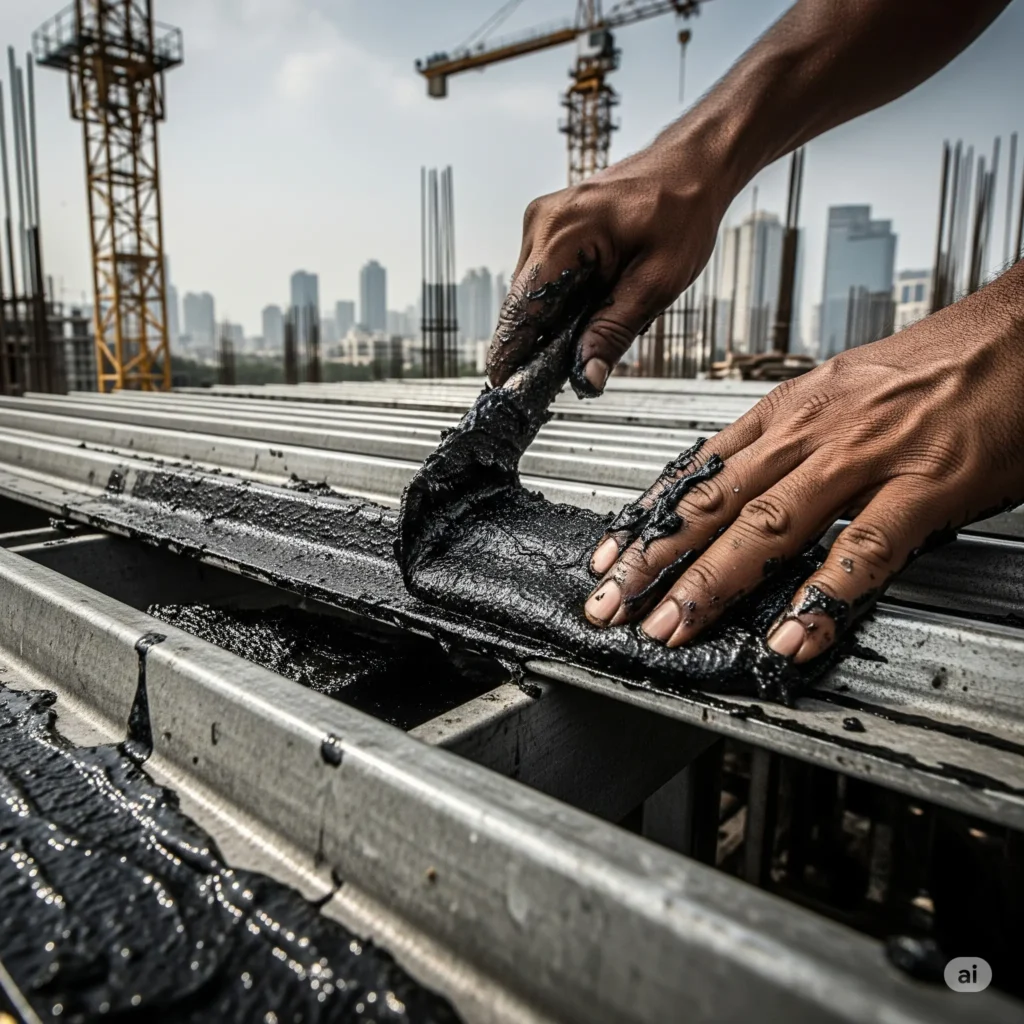
To protect shuttering plates, props and tie rods through the monsoon, clean off slurry, remove loose rust, let the steel dry, then coat threads and bare steel with a thin film of yellow (batata) grease. Store everything off the ground under a ventilated cover, check after heavy rain, and re-grease any bare spots.
On Mumbai and Thane sites, the June to September rains are when steel formwork loses value fastest. Props that turned freely in March seize by July. Tie rod nuts stop spinning off. Plates come out of the yard with an orange face that marks the next slab. Most of this is prevented by an hour of work per stack before the rain and a few minutes of checking during it. This guide covers what to coat, how, and where grease should not go. For the product and rate, see our yellow grease (batata grease) page.
What rusts first in a shuttering yard
Rust starts where water sits and where steel is bare: threads, cut edges, pin holes and any face scraped clean during stripping.
| Item | Where rust starts | What it costs you | Grease? |
|---|---|---|---|
| Steel shuttering and centring plates | Face, edges, stiffener joints | Pitted face marks concrete; extra cleaning | Thin film for storage only |
| Adjustable props | Thread, nut, inner tube, pin holes | Nut seizes; height cannot be set | Yes, thread and nut |
| Tie rods, she-bolts, wing nuts | Threads | Nuts jam; rods scrapped early | Yes, threads |
| Cuplock base jacks and U-heads | Screw threads | Jacks seize at the wrong height | Yes, threads |
| Clamps, pins and wedges | Contact faces | Jam at stripping | Yes, thin film |
| MS strips on plywood panels | Cut edges and holes | Rust stains on the concrete face | Site practice, see below |
The pre-monsoon routine
- Sort. Separate plates, props, ties and small hardware. Put bent props, cracked plates and damaged threads aside for repair or scrap.
- Clean. Scrape off set slurry. It holds water against the steel and hides rust underneath.
- Remove loose rust. Wire-brush threads and bare patches until the steel is firm. Grease over flaking rust peels off with it.
- Dry. Let everything dry fully in the sun. Grease spread on wet steel traps the moisture under the film.
- Coat. Brush a thin, even film on threads, nuts, pin holes and bare steel. A thick lump collects grit and gets wasted.
- Store. Stack off the ground and under cover, as set out below.
Do this in May, while the yard is dry. Coating in the first week of rain means greasing damp steel, which protects far less.
How to coat each item
Shuttering and centring plates
What is documented: formwork suppliers recommend a rust preventive or a release oil made for steel, and note that grease or diesel gives only limited protection and must be re-applied. Oils made for timber forms are not suited to steel.
Common site practice: many yards wipe a thin film of batata grease over stored plates because it is cheap and resists rain. If you do this, wipe the face back to a very thin film, or clean it and apply your normal release agent, before the plate goes back on the deck. Formwork makers warn that excess release coat spoils the concrete finish, and a thick grease film is worse than a thin oil one.
Props and prop threads
Brush grease onto the outer thread and run the nut up and down once to carry grease into it. Wipe the inner tube where it slides. Keep the pin and its holes lightly coated. A prop that turns freely saves time on every floor.
Tie rods, she-bolts and wing nuts
Grease the threads and spin the nut on and off. Formwork accessory makers advise greasing the removable part of a she-bolt so it releases from set concrete. Keep grease off any part meant to bond into the wall, and do not grease a bolt that must be tightened to a set torque unless the engineer approves it, because grease changes the tension a given torque produces.
Cuplock base jacks and U-heads
Galvanised tubes have their own zinc protection, so grease only the screw threads of jacks and U-heads. Coat them before storage and again after any long spell in the rain.
Plywood panels and MS strips
Documented: plywood faces take a release oil, and cut edges and drilled holes are sealed with water-resistant paint, because unsealed edges are where water gets in. Site practice, not a standard: some crews wipe a thin film of grease on the steel strips or angles that edge a ply panel to slow rusting. Keep it off the ply face itself.
Storing formwork through the monsoon
- Off the ground. Stack plates and props on timber bearers so water runs under them, not into them.
- Covered on top, open at the sides. A sheet tied tight to the ground traps humid air and condensation. Cover the top and leave airflow.
- Small parts in lidded bins. Greased pins, wedges, nuts and clamps go into covered bins or bags, sorted by type.
- Grease stock in the shade. Keep pails closed with the lid on, and decant with a clean scoop so slurry does not get into the whole pail.
During the rains: what to check
After each heavy spell, walk the yard. Look for orange spots on threads, bare patches on plates and water standing in stacks. Re-grease bare steel as soon as it is dry. Hardware coming back from the deck should be cleaned on the day it comes back, before slurry hardens, then re-coated before it goes back into storage.
Using diesel or used engine oil as a rust coat. It is thin, runs off in rain, picks up dust and can stain concrete. Hardware ends up rusting under a dirty film.
Where yellow grease should not go
Yellow grease is a low-cost grease for slow, wet, lightly loaded points. KE does not recommend it for passenger or material hoists, wire ropes, crane slew rings, or any point where the equipment maker specifies a grade. Follow the maker’s lubrication chart there. On concrete contact faces, use a release agent, not a grease coat.
How much to buy and how to order
There is no standard kg-per-tonne figure for coating formwork. Weigh a pail before and after coating one stack, then scale to the yard. KE quotes yellow grease at Rs 65 per kg, plus delivery and GST, and supplies any quantity. Consistency is made to the requirement: if hardware sits in direct sun, ask for a firmer grease. Ask for a sample and try it on a few props before ordering, using the checks in how to check batata grease quality. Rates are explained in our batata grease price guide, and the grease-or-oil decision for shuttering is in batata grease for shuttering.
Krish Enterprises, K.J. Complex, Diva, Thane 400612. Call or WhatsApp +91 96194 84337.
Frequently asked questions
How do I stop shuttering plates rusting in the monsoon?
Clean off slurry, wire-brush loose rust, let the plates dry, then apply a rust-protective coat. Stack them off the ground under a cover that leaves the sides open, and check after heavy rain.
Can I use batata grease on stored shuttering plates?
Many yards do, as a thin film. Before the plate is used, wipe the face back to a very thin film or clean it and apply your release agent, because excess grease marks the concrete.
Should props be greased before the monsoon?
Yes. Grease the outer thread and run the nut along it, and lightly coat the pin and its holes. It stops the nut seizing.
Is diesel or used engine oil good enough for rust protection?
No. It is thin, washes off in rain, collects dust and can stain concrete, so steel rusts under it.
Do galvanised cuplock parts need grease?
Only on the screw threads of base jacks and U-heads. The galvanised tubes have their own zinc coating.
Can yellow grease be used on hoists or wire ropes?
No. Use the lubricant the equipment maker specifies for hoists, wire ropes and slew rings.